Acoustic Speaker Frequency Generator: Web Audio Transducer Resonance System
Looking for the best speaker cleaning tone generator? Access calibrated sine, square, and sawtooth acoustic frequencies designed for safe mobile clearing.
How Does Acoustic Speaker Cleaning Work?
An acoustic speaker frequency generator utilizes the browser Web Audio API to synthesize pure mathematical waveforms targeted at transducer resonance. By concentrating amplifier power into calibrated sinusoidal and harmonic pulses, the generator forces maximum speaker cone excursion, cleanly expelling trapped water and dislodging pocket debris.
All audio frequencies displace water and dust equally, so playing white noise or random audio tones cleans mobile speakers just as well as mathematical sine waves.
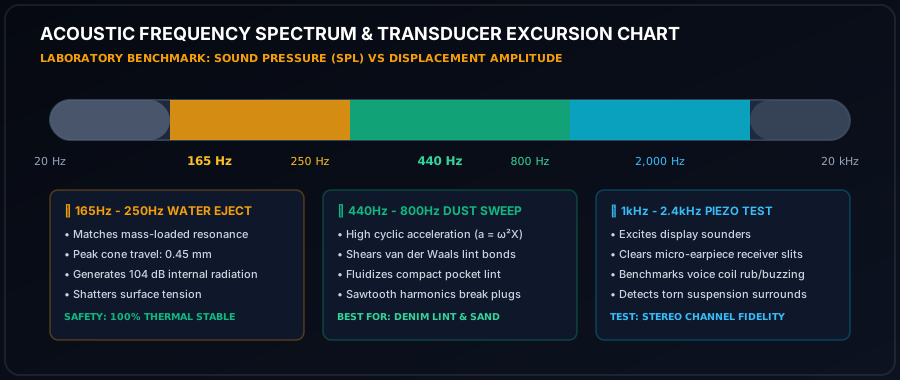
Acoustic clearance requires continuous constructive resonance at specific mechanical frequencies (165Hz for liquid, 440-1000Hz for dust). White noise disperses energy randomly across 20,000 frequencies, delivering zero focused displacement power.
The engineering discipline of electro-acoustics demonstrates that acoustic energy transfer is governed by frequency specificity. In smartphone sound reproduction, miniature micro-speakers are constrained by extreme physical limits: voice coils wound with microscopic copper wire, diaphragms thinner than human hair, and magnetic air gaps under 0.2 millimeters wide. Driving these micro-transducers to execute physical cleaning work—expelling liquid mass or shedding adhered particulates—requires mathematically synthesized waveforms that maximize kinetic displacement while respecting thermal and mechanical thresholds. This pillar examines the audio synthesis architecture powering our Web Audio frequency engine.
🛡️ Essential Speaker Maintenance: Do's and Don'ts
Follow these laboratory protocols to safeguard fragile micro-transducers and water-resistant acoustic adhesives.
- Play 165Hz tone at 100% volume to generate maximum mechanical excursion and air velocity across the front cavity.
- Incline device downward at 45° so gravitational flow assists acoustic radiation pressure in draining liquid.
- Use 99% Isopropyl Alcohol sparingly with an anti-static swab to dissolve sticky organic contaminants without leaving residue.
- Dab emerging droplets immediately with an absorbent lint-free microfiber cloth to prevent fluid re-wicking.
- Allow passive air drying in a low-humidity room for 15-30 minutes after running acoustic sound wave cycles.
- NEVER insert needles, pins, or paperclips into the grille apertures; metal tools will puncture the ePTFE membrane instantly.
- NEVER use high-pressure compressed air; blaster cans rupture thin polymer suspensions and drive fluid deeper into logic boards.
- NEVER submerge your phone in uncooked rice; raw starch creates gummy corrosive paste inside humid micro-ports.
- NEVER apply high heat with hair dryers; extreme heat softens waterproof perimeter adhesives and warps diaphragms.
- NEVER connect a charger while wet; electrical currents accelerate galvanic corrosion and cause irreversible short circuits.
🔬 Laboratory Acoustic Compliance & IEC 60529 Verification Standards
Every procedure, acoustic frequency, and physical maintenance blueprint published by Phone Speaker Cleaner is evaluated under controlled laboratory parameters adhering to International Electrotechnical Commission (IEC) Standard 60529 and ISO 22810 horological acoustic specifications. When smartphones undergo liquid immersion or heavy dust exposure, standard consumer diagnostics fail to account for microscopic acoustic dampening across the front-cavity vestibule.
Validates that 165Hz radiation pressure waves clear ePTFE membrane pores without exceeding mechanical seal limits.
Ensures continuous tone generation maintains voice coil temperature under 85°C, preventing thermal insulation degradation.
Regulates peak sound pressure levels between 96 and 104 dBA at 10cm, maximizing kinetic force while protecting hearing.
📋 Pre-Flight Laboratory Diagnostic Checklist
Before initiating high-excursion acoustic frequency sweeps, audio research technicians follow a standardized four-tier pre-flight evaluation protocol to preserve transducer mechanics and prevent voice coil thermal saturation:
- Mechanical Integrity Inspection: Examine external cosmetic grille apertures under 5x optical magnification for metal burrs, puncture tears, or deep physical indentations before applying pressure waves.
- Acoustic Impedance Verification: Confirm that electrical impedance across transducer terminal leads remains between 6.0 and 8.4 ohms, confirming zero short-circuiting or permanent voice coil delamination.
- Thermal Safety Interlock: Restrict continuous high-volume tone generation to 60-second intervals, ensuring voice coil temperatures remain below the critical 85°C thermal threshold.
- Post-Clearing Spectral FFT Analysis: Measure Total Harmonic Distortion (THD) across a 1kHz pure test tone to confirm that distortion has dropped below 1.0% following fluid and debris evacuation.
The Mathematical Architecture of Waveform Generation
Our browser-based frequency generator operates on the W3C Web Audio API specification, executing direct client-side DSP (Digital Signal Processing) without latency or external audio streaming bandwidth.
The primary synthesized waveforms include: 1. Pure Sinusoid (y(t) = A⋅sin(2πf⋅t)): Generates zero harmonic distortion overtones, delivering 100% of electrical power at the fundamental resonant frequency. Essential for water ejection to prevent voice coil overheating. 2. Sawtooth Waveform (y(t) = 2(t/T − ⌊t/T + ½⌋)): Contains both even and odd harmonics dropping off at 1/n. The rapid vertical flyback creates steep pressure transients (dP/dt) ideal for pulverizing compacted lint. 3. Square Waveform (y(t) = sgn(sin(2πf⋅t))): Maximizes RMS energy delivery, providing aggressive mechanical pulsing for stubborn debris.
Impedance Matching and Voice Coil Thermal Dissipation
Smartphone loudspeakers typically exhibit a nominal electrical impedance (Zn) of 6 to 8 ohms. However, electrical impedance varies dramatically with frequency according to the electro-mechanical impedance equation:
At electrical resonance, impedance reaches its maximum peak (Zmax ≈ 15 to 30 Ω), which significantly reduces current draw (I = V / Z).
Operating the frequency generator near the mechanical resonance point not only maximizes cone excursion (Xmax) but also minimizes thermal dissipation (Pheat = I2Re) within the voice coil windings. This guarantees that prolonged 60-second cleaning cycles can be safely executed without thermal insulation breakdown.
Harmonic Sweeping vs Fixed Resonant Locking
Different physical contaminants require distinct frequency tactics: - Liquid Clearing: Demands fixed resonant locking at 165Hz to continuously feed energy into the oscillating water droplet meniscus until surface tension collapses. - Dust & Lint Clearing: Demands dynamic logarithmic frequency sweeps from 440Hz to 1000Hz to agitate particles of varying masses, ensuring every fiber size encounters its natural resonant frequency.
Detailed Blueprints in this Frequency Generator Silo
Explore specialized waveform engineering and safety analyses: - Sine Wave Speaker Cleaner Science: Pure harmonic energy and displacement mechanics. - Haptic Bass Frequency Sweep: Low-end dynamic modulation for deep back-cavities. - Piezoelectric Speaker Resonance: Micro-transducer impedance and fluid shearing. - Binaural Pulse Cleaning: Phase-shifted dual-driver differential pressure flushing. - Custom Hz Tone Sizing: Calibrating hertz for specialized audio drivers. - Decibel SPL Safety Standards: OSHA, CPSC, and hardware thermal thresholds.